Hachijojima lies some 290 kilometers south of central Tokyo. Less than an hour by plane from Haneda, or reached by rocking through the night on a ferry, it is part of Tokyo's island district. Though it is the same "Tokyo," the air the instant you set down at the airport is utterly different. The moisture-laden wind is somehow sweet, phoenix palms flourish in deep green, and two volcanoes — Hachijo-Fuji with its gentle ridgeline, and Mount Mihara rising as if to face it — stand embracing the island from either side. Warm, deep in green, ringed by the Kuroshio Current's sea, and yet on this island vacant houses go on increasing, quietly but surely.
An island has its own time. The cultivation of foliage plants and cut leaves goes on, the kihachijo weaving handed down on the island since olden times is carried on, and in the slope-ridden hamlets people head out to the fields from early morning. On a rise overlooking the sea there is a hot spring, where, soaking in the water, you can take in the whole Pacific stretching to the horizon. Scheduled ships come into the harbor, tying a thin thread to the world beyond the island. And still, the younger generation leaves the island for school and for work, and the houses left behind grow quietly still, one by one, their storm shutters closed. Even on an island ringed by sea and flooded with light, when the people dwindle the houses empty. That reality resembles, to an astonishing degree, the mountain hamlets of the mainland. Abundant nature, and vacant houses on the rise: the two are the front and back of the same island. Left alone, a vacant house becomes a burden that only deteriorates. But once the next person to live there is found, it turns into a doorway that calls people back to the island. Across the sea there truly are people searching for a quiet "Tokyo." All that remains is how to bring that person and this one house together.
The Value of "an Island of Tokyo"
For an overseas remote worker, the place name "Tokyo" holds, in itself, a powerful pull. On a job posting, on a business card, that one word alone changes the view. But what they actually wish to obtain is not the crowded downtown intersection you see in photographs. A base that is quiet, reliably connected to the internet, and low in the cost of living — that, at heart, is the condition.
Hachijojima meets those conditions to a surprising degree. Though it is a "Tokyo" with an airport, in the morning you wake to the sound of waves, at midday you work between volcano and sea, and at night, in an astonishingly dark sky, stars come out as if spilling over. Rents and prices bear no comparison with the city center; even a detached house with a garden is within reach. Factor in the time difference, and working with colleagues in Europe and America means you can, if anything, sleep and wake at hours that suit you. To focus on work on the quiet island by day and get through overseas meetings before dawn — even that way of working holds together on this island. Send a would-be buyer overseas a photo of this island, and the same reaction comes back without fail: "Is this really Tokyo?" What they had been looking for was exactly this kind of place — "one step removed from the city, and yet still Tokyo."
In fact, spend a few days on the island and you find that way of working is no pipe dream. The hamlets are astonishingly quiet by day, with nothing to stay your hands at the screen. Open a window and there is the smell of the tide and the calls of birds, and in the distance the deep green of the phoenix-palm fields. You advance a day's work while your overseas colleagues sleep, and slot in one short meeting around the time they wake. There are those who say that a focus which in the din of the city center tended to come in fragments held, on this island, astonishingly long.
That said, they have their anxieties too. What about medical care and shopping? How rough does it get in typhoon season? If the ships and planes are canceled, might they be shut in on the island? On a day when a strong sea wind drives in, one look at the gray sky and the white crests of the waves and you understand that yearning alone will not let you live here. The beauty of a photograph alone will not dispel that anxiety. Which is exactly why the time spent actually living on the island for a few days counts. Decide after you have seen both with your own eyes — the good, and the parts that call for resolve.
To move here from across the sea means, ahead of buying a house, resolving on a way of life. Having taken it all on — the rough sea, the days of canceled crossings, the scarcity of shops — can you still feel that here is where you want to be? To that question, no brochure has an answer. The only thing that can answer is your own body, which has actually been blown by the island's wind and passed the island's nights. That is precisely why we have them come. See, touch, waver, and then decide.
Crossing the Language Barrier With a System
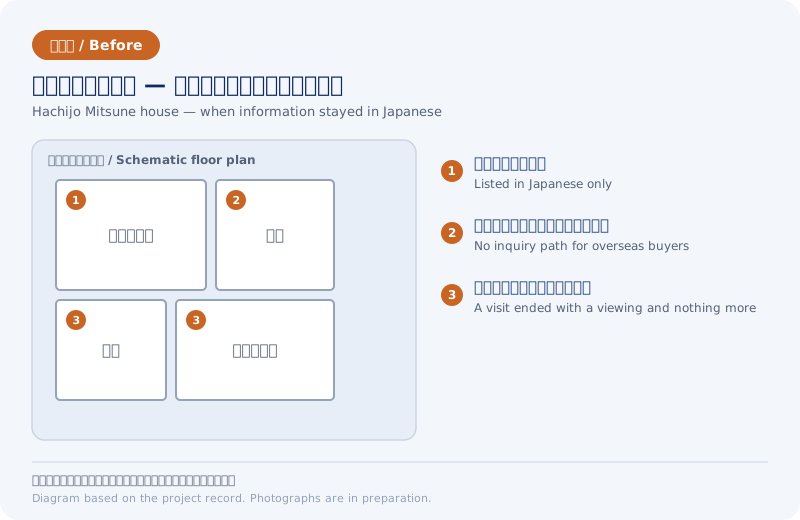
That said, information about the island's vacant houses has all along stayed closed inside the Japanese language: local notices, and inquiry desks in Japanese only. By that alone, the property that matters will never reach the hands of someone who, across the sea, responded to the word "Tokyo." Between the interest and the property stood a high wall of language. However many vacant houses the island may have, and however many people across the sea may want to live there, if the two cannot meet, the house merely grows old.
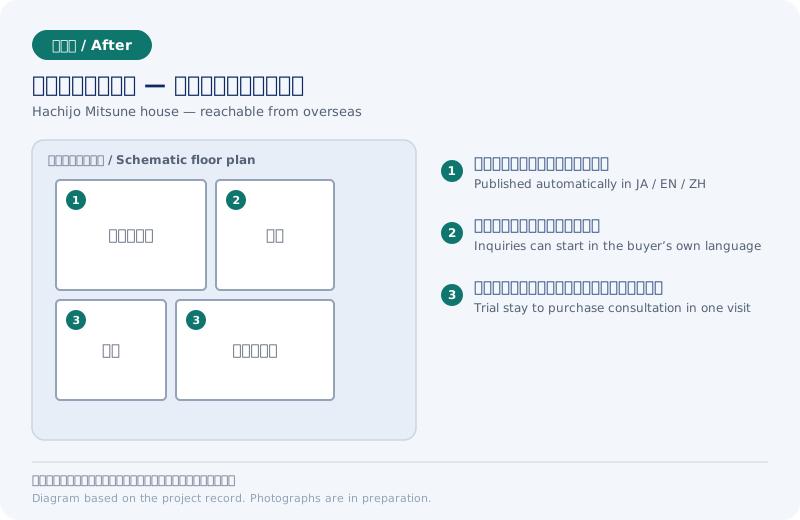
So we set about arranging property information automatically in Japanese, English, and Simplified Chinese, and sending it out so that the same information reaches the screen of a would-be buyer across the sea, too. The photos, the floor plan, the rough costs — all readable in one's native language. An inquiry can be begun in one's own words, without having to wring out halting Japanese. One would-be buyer, they say, was struck first of all, after sending a first message written in their native tongue, by the fact that the reply came in the same language. "There is someone here I can make myself understood to" — that reassurance turned a far-off island, all at once, into an option with real substance. Crossing the language barrier by a system rather than by sheer grit works better than you might think. Because whether or not you can write that first message in your own words is, for someone across the sea, the very question of whether or not you can begin the conversation at all. The reply, too, arrives in one's native language, and things proceed in that same language all the way to an online meeting across the time difference. The reassurance that one's words get through makes even the distance of the sea feel a little closer.
Once the words get through, the very quality of the questions changes. Not just surface matters like floor plans and prices, but questions that touch the core of living — "Is it really warm even in winter?" "What about schools for the children?" "How long does it take to reach a hospital?" — come out naturally in one's native language. To each and every one of these we reply carefully, in that same language. As the exchanges build up, the person on the other side of the screen begins to picture, concretely, not a property on a far-off island but the life of their own that is about to begin.
The Trial Stay Shrinks the Distance
That said, for a buyer living overseas, the burden of the round trip to the island is by no means small. Changing between plane and ship, sometimes making the journey again and again — not many can repeat that lightly. Distance is the most real of the walls that, at the very last, holds back a move from abroad. Each round trip piles on time and expense, and it is not unusual for the enthusiasm to cool in the meantime. The feeling of "I want to live here," so hard-won in its budding, is quietly worn away by distance.
That is exactly why we want to make that one trip to the island as fruitful a stretch of time as possible. Precisely because the burden of travel is large, the meaning you can load onto a single visit can be made large too. Not a half-day of merely touring properties, but a few days in which they test the living, ask their questions on the spot, and go home having settled even the next arrangements. To cut the number of round trips is, in the same stroke, to shorten the period spent dragging along an unresolved indecision. For someone crossing the sea, it is the density of that one trip, above all, that helps most.
That is exactly why a design that lets one advance, within a single visit, from "trial stay" to "purchase consultation" quietly takes effect. A ship comes into the harbor, or you set down at the airport, and then, for a few days, you actually stay in the vacant house and confirm the island's living with your body. In the morning you watch from the veranda as cloud settles over Hachijo-Fuji's ridgeline; at midday you walk the slopes between spells of work; at night you sleep amid the unbroken sound of waves. The damp air so typical of a southern island, the sea wind that drives in harder than you had thought, the earliness of the hour when the island's shops close — over those few days you can confirm textures that a photograph could never have told you. In the evening, soaking in the hot spring on the rise, gazing at the darkening sky and sea, some say they could picture concretely, for the first time, their own figure living on this island.
A house seen under the light of day, and a house where you have spent the night, make for entirely different impressions even as one and the same house. The depth of the dark when you close the storm shutters, the pleasure of waking to birdsong in the morning, whether the flow of movement is good or bad when you stand in the kitchen. Live there a few days and even the house's quirks, which a photograph could never convey, gradually come into view. Whether you fall for it or let it go, a judgment made after confirming with the body has a strength that will not waver afterward.
Over a few days, chances to exchange words with the island's people arise too. Pass someone at the edge of a field and a nod comes back; lose your way and they tell you where to go as a matter of course. A distance where faces are visible, unlike the anonymous life of the city. Whether you find that a nuisance or a source of strength — the stay of a few days quietly teaches you even that compatibility. And before the warmth of the stay cools, you go ahead and consult, all at once, on everything from a funding plan to an online meeting. You turn the "someday" in your head, on the spot, into a "when."
For someone who has crossed the sea, the greatest enemy may be the enthusiasm that cools, little by little, after the return home. Back in daily life, the memory of the island gradually fades, and only the bother of the paperwork remains at hand. So, during the stay, when feelings are at their warmest, we make sure that even the next step is in view. If both the funding outlook and the arrangements ahead are put into concrete words while still on the island, then even after going home one can proceed without wavering.
Gathering the arrangements around the time of the visit, so as not to make someone who has come all the way across the sea travel back and forth again and again. Making it possible, in a single stay, to settle both the felt sense of living and the purchase consultation at once. That is why AkiyaWay has prepared multilingual outreach and the trial stay as one continuous flow. For the island's people, too, a house whose storm shutters have stayed closed passing into someone's hands, and a light coming on in it once more, must be a quiet joy. Distance can be shrunk not by willpower but by arrangement. When someone who gazed at the morning sea from a Hachijojima veranda next comes to this island, they will be sitting down on that same veranda not as a traveler but as a resident — a house with its shutters closed will greet that person's morning once again. For such a day, we are quietly waiting.