A dual-income couple working in Tokyo had, at some point, come to yearn for a two-base life in which they spent just the weekends in the countryside. On weekdays they were chased by packed trains and deadlines, and by Friday night both of them were worn to the bone. Night after night they ate the ready-made dishes bought at the convenience store on the way home in silence, without even turning on the television. They wanted, somewhere, a place where they could step off the train and breathe. It needn't be a fancy second home — if only they could wake, on weekends, in a place that smelled of earth. Repeating that conversation over and over, the candidate that came up was an old detached house in Hikawa, Okutama, standing on a slope overlooking the Tama River. Within walking distance of Okutama Station, and about two hours by train from the city center. Change to the train waiting across the same platform at Ome Station, and from there a single line carries you to the end of the valley. On the map, it looked like a dream with a good deal of reality to it.
And yet the two could not quite take that final step. On every day off they toured house after house, nodding each time — "It's a good house" — but when it came to signing, they could not decide. It was not that something was missing, but that there was too much they had not been able to confirm. Whenever the talk turned to price, the two would fall silent without fail. Could you decide on the biggest purchase of your life on an impression of just thirty minutes? — that question always rose up at the last. One house had good sunlight, another was near the station; each had its reasons to draw them. But none of them tipped the balance.
What a Viewing Cannot Tell You
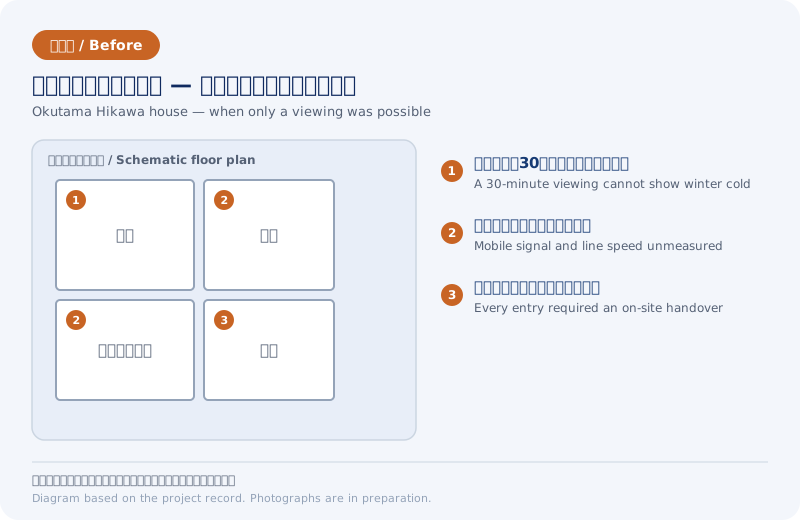
On a viewing in the fine light of early afternoon, a house always looks good. The light through the windows is soft, the veranda is warm, the sound of the river is easy on the ear. Real-estate photos, too, are mostly taken at the hour when conditions are at their best. But what the couple really wanted to know was not that kind of "moment when it looks good." The winter morning's deep, penetrating cold, enough to make you hesitate to leave the futon. The night's stillness after sundown, so complete it makes your ears ache. And, the thing that would make or break their work, an internet line and a mobile signal that could truly stand up to remote work. None of these can possibly be known from a thirty-minute viewing.
And a viewing is invariably scheduled for the daytime, in good weather. The forlornness of the slope on a rainy day, the darkness after the sun goes down, the chill of a weekday morning — all of it slips clean out of that thirty-minute frame. The people showing you around mean no harm. It is simply that the system is set up, from the start, so that you see only the house's best face. What the two really wanted to know was not that dressed-up best face, but the bare one. Could you decide on a lifelong relationship with a partner you only ever meet on a sunny afternoon?
Okutama, though part of the same Tokyo, has a climate utterly different from the town. The Tama River and the Nippara River that flows into it carve deep valleys, and hamlets cling to the valley floors and slopes. Winter mornings run several degrees colder than in the town; needle ice heaves up the soil, and each breath trails away white. The slope from Okutama Station up to the house grows slick with fallen leaves the morning after rain, and the wind crossing the ravine is colder than you would imagine. The wife, they say, voiced the same thing again and again during the viewing: "Will this place really be all right in winter?" That anxiety, which a photograph can never convey, was the single biggest reason the two could not take the plunge to the very end.
There was one more worry they did not speak aloud: work. Both of them worked in a way that had them joining meetings from home half the week, and if the signal was weak, this house would end up as nothing more than "a house you can only come to on weekends." Conversely, so long as the line was alive, they could come from Friday afternoon and work here until Monday morning. The same house takes on an entirely different meaning depending on one thing: the state of its connectivity. Neither the photos nor the floor plan lists the strength of the signal. Buy, or give up. Between dream and reality, the two marked time for a long while. The deciding factor simply would not turn up.
Three Days, Two Nights: Actually Living There
What the couple chose, then, was to actually live there — on a three-day, two-night trial stay — before deciding to buy. Rather than piling on one more sunny-afternoon viewing, they would spend a morning, a night, and the next morning through, in this house.
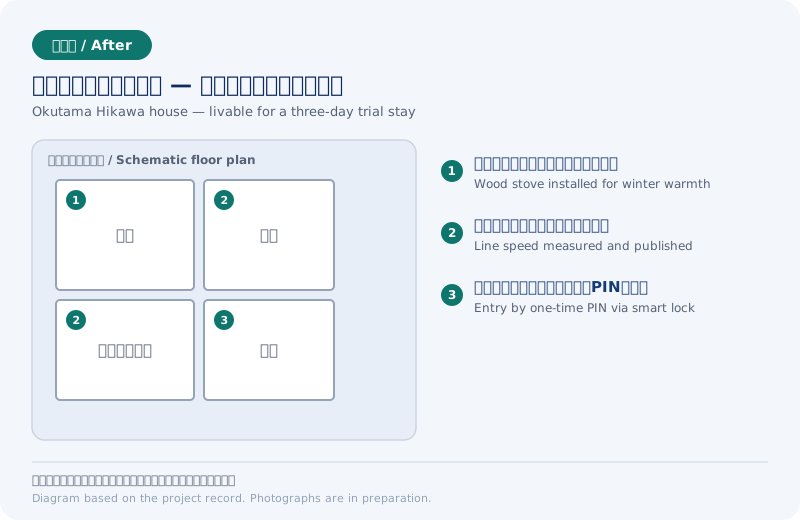
On the day they arrived, they let themselves in — just the two of them — punching into the front-door smart lock the one-time PIN that had reached them in advance. The single fact of not having a real-estate agent at their side was, they say, bigger than they had expected. Minding no one, with no need to hush their voices, the two boiled water in the kitchen and made dinner from ingredients bought at a shop along the way. Outside the windows it went dark in no time, and only the sound of the river wrapped the house. At night, when they switched off the lights, a kind of stillness they had never once tasted in the city center came slowly down from above. Until their ears grew used to it, it was a stillness unsettling, if anything. Somewhere far off came what sounded like the cry of a deer, and the two turned to each other without thinking. Stepping out onto the veranda, they found more stars than they had ever seen in the city spread out above the valley.
For a while the two gazed up at those stars without a word. On the daytime viewing, they had not even known this sky was there. They had assumed that choosing a house meant choosing a floor plan and a price. But in truth it means choosing, whole, the time that a piece of land holds — the morning light, the night's stillness, the very sky you look up into. Only now did it fall into place for the two of them. The substance of living lay precisely outside the photographs.
Morning came cold, exactly as they had imagined. The flooring was cold to bare feet, and a faint condensation clung to the inside of the windows. Even so, once they lit the built-in wood stove, the room warmed far sooner than they had thought. The crackle of dry firewood, and the heat spreading little by little. The husband tried splitting some of the wood from the shed, and grew, they say, unexpectedly absorbed in the feel of it. "As long as there's a wood stove, we could probably get through the winter somehow." The time spent brewing coffee while he murmured this felt, to the two of them, oddly luxurious. And then, the crux of it: work. They opened a laptop in the living room and actually joined an online meeting. The video did not cut out; the voices did not lag. "The signal's much better than we thought." Turning to their colleagues on the other side of the screen, the two caught each other's eye and laughed. The "two-base life" they had worried over only in their heads turned, over those three days and two nights, suddenly into a reality they could touch. It was the moment the resolution of their life jumped up all at once.
On the second day, they deliberately tried working just as they normally would. They got through meeting after meeting from the morning, spread out a boxed lunch on the veranda at midday, and on the afternoon break went down a little toward the river. The green of the valley they looked up at between tasks, and the smell of the wind that passed now and then, made for a flow of time utterly different from a downtown office. The sense of release after closing the laptop in the evening was, they say, beyond any comparison with before. Here, working and living become seamlessly continuous, without strain. The true nature of the yearning the two had never been able to put into words was, most likely, just this.
The night passed slowly — opening a book they had brought, talking over the next day's menu. They did not turn on the television. The nights that in their downtown flat had been nothing but exhausted, silent mouthfuls of ready-made food filled here, naturally, with conversation. They were supposed to be the same two people, and yet, merely from a change in where they were set down, could the passing of time differ this much? It was that fact, the wife told us later, that surprised her most of all.
In the early afternoon they walked a little way to the banks of the Tama River. The ravine's water was astonishingly clear, the stones of the riverbed cold, and from upstream the calls of birds came falling ceaselessly down. At a field's edge where they stopped on the way back, a local said "here, if you'd like" and shared some freshly picked vegetables. When they thanked her, back came words so frank they made the couple bashful: "It makes us happy too, you know, when more people come." That one remark, they say, stayed in their hearts a long time. In the city they had spent years without even knowing who lived next door. Here, the locals were already half-welcoming the two of them, who had not even moved in yet. That closeness — a nod returned as a matter of course when you pass someone — was another thing a thirty-minute viewing could never reveal. What the three days and two nights cost them was no more than about the price of a night's lodging, plus a weekend's time. And yet what they gained there was something no number of daytime viewings could ever have brought them.
The Deciding Factor: The Felt Sense of "We Could Live Here"
On the train home, their minds, they say, were already made up. Watching the ravine scenery flow past outside the window, one of them — neither quite first — said, "Shall we go for it?" In the end, the couple bought this house in Hikawa. What tipped the balance was not the price, nor the size of the floor plan, nor the distance from the station. "We could live our weekends here" — that felt sense, confirmed with their own bodies, and that alone, pushed the two of them forward. Not the conditions lined up in their heads, but the sensation left on their skin over three days and two nights, made the final step possible. As if all that wavering had been a lie, on the day of the contract the two had no hesitation left.
After deciding to buy, the two reported it to their parents in Tokyo as well. The parents, who had at first fretted — "way out in the mountains like that" — gradually eased their expressions, they say, as they listened to the story of the three days and two nights. The single phrase "we actually tried living there" has a power to convince that no brochure can match. Not a house chosen in the head, but a house chosen with the body. That certainty slowly dissolved the anxiety not only of the couple themselves but of the people around them, too.
For a buyer, a trial stay is a means of shrinking the risk before a big purchase. The winter cold, the night's stillness, the strength of the signal — all can be confirmed as fact rather than imagination, and only then decided upon. And the same mechanism holds meaning for the seller as well, because it prevents, in advance, someone ill-suited from buying on impulse and coming to regret it. A mismatch wounds the buyer, the seller, and the valley hamlet itself. A house you have let go being taken by someone who cannot keep the living up, only to revert to a vacant house — that is an ending no one wishes for. The reason AkiyaWay cherishes the doorway of the trial stay is that we want this valley's way of life to reach, without strain, only those who can truly keep it up. To someone who can go on smelling, next winter and the winter after that, the scent of firewood they caught on the morning of a three-day, two-night stay. Consultations from afar and the arrangements for a purchase alike can be advanced together, around the time of the visit. Deciding can wait until after you have tried living there.