The old farmhouse in Nariki, Ome, is an eighty-year-old house with a sunken hearth and a wide veranda. Drive from the town center of Ome up into the folds of the mountains, and the road eventually narrows to follow a valley, with slopes of cedar and cypress pressing in from either side. Nariki has always made its living from the mountains — from lime-burning, whose product went into the white plaster walls of Edo Castle, and from forestry — and its houses huddle together on the few flat scraps of the hillside. This house, too, stood with a planted cedar wood at its back and a thin river running along its flank. Beyond the murmur of the stream and the wind stirring the treetops, almost nothing reaches the ear. In summer the grass around the house grows as tall as a person; in autumn fallen leaves drift right up to the veranda. Leave it untended, and the mountain will set about swallowing the house at once.
The first time I laid a hand on the sliding door, it was a frost-covered winter morning. The door, warped out of true, caught once partway, and when I forced it sideways, dust and the smell peculiar to a house whose air has long gone still — damp tatami and earth — hit my nose all at once. On the packed-earth floor of the entrance stood two pairs of muddy rubber boots, left facing exactly the way they had been the last time someone stepped out of them. No one can any longer say for certain how many years it had been since the last resident left. The kitchen windowpane was clouded white, and the clock on the pillar had stopped. In the inner room an old Buddhist altar and a Shinto shelf remained untouched, faded artificial flowers set before them as offerings. What stood here was not the "charming old farmhouse" of a photo book, but "a house whose clearing-out, and whose mourning, were not yet finished."
Walking through the rooms one by one, I found the leftovers of a life scattered everywhere. On the kitchen pillar, the notches of a child's growth measured year by year; in the closet, floor cushions still folded; in a corner of the veranda, a well-worn bamboo broom. Turn the tap, and for a while nothing but rusty, cloudy water came out. In a house long untouched by human hands, the house itself is slowly trying to return to the soil. Once, the people of this land made their living from the mountains, and in time the children and grandchildren left for the city. The house they left behind became a vacant house quietly, without holding a grudge against anyone. To turn this place back into somewhere a person could sleep again — that single aim was where the work began.
Around the hearth, some trace still lingered of a family that had once sat in a ring on the floor. Long years of woodsmoke had lent the ceiling an amber sheen, and thick beams held the whole house down with a solid weight. Framing like this you could never obtain the same way again, however much you tried to build anew today. That is exactly why there is meaning in taking the time to bring it back to life, rather than tearing it down for an empty lot. It takes labor. And yet, picturing someone once more living and laughing beneath these beams, each single day of clearing out took on, strangely, a certain spring.
First, Bring the Left-Behind Belongings Down to Zero
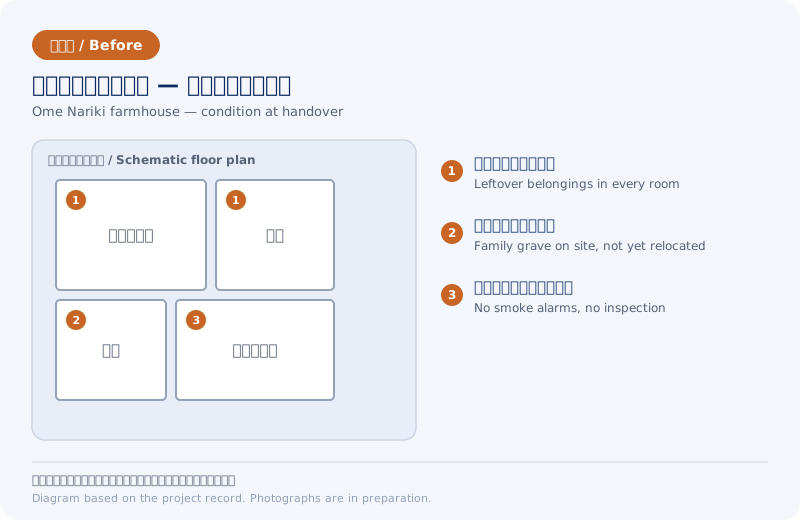
The former resident's household goods, rusted farm tools, futons gone faded and heavy, chipped teacups left face-down and gathering dust in the kitchen cupboard. The single biggest reason a vacant-house sale struggles to move forward is, in truth, not the deterioration of the house itself but these left-behind belongings. In a room where the lingering scent of another person's life hangs thick, no one can picture a life of their own. It is hard to imagine as "my home" a house from which, each time you open the closet, the presence of some stranger spills out.
We began by enlisting a professional clearance company, along with people who had long been involved in tidying vacant houses in the area, and emptied the rooms one by one. From the back of the closets came bundles of old photographs, letters with their addressees' names gone faded, even what looked like old certificates bearing seals. Such things we did not throw away on our own judgment; we handled each one only after checking with the owner or their relatives. Time and again there are moments when no outsider can make the call of whether to discard or to keep. The Buddhist altar and the Shinto shelf we carried out only after pressing our palms together in proper prayer and having the spirits duly removed in the appropriate rite. This is a step that must not be hurried.
When, over the phone, I described the bundle of letters that had turned up, the owner fell silent for a while. He seemed to recognize the hand of a distant relative, and asked that at least those be sent to him. Even in a house whose contents one has been asked to clear away, there is always, somewhere, a single bundle that cannot be thrown out. The work is not something that finishes in a day. Starting in the morning while frost still lingers in the valley, we carried things out until the sun dropped behind the far ridge, and repeated this for days on end. The volume of household goods hauled away came to several light-truck loads, and the workers, masked against the dust, had sweat beading on the backs of their necks even in winter. Because there is no telling how much there will be, clearing out left-behind belongings makes the cost hard to predict as well; it is not unusual for an estimate to run into the hundreds of thousands of yen. And yet, skip this and the house will not sell. During the work, a local passing nearby stopped and called out, "So this place is finally getting cleared, then?" The ones who had worried most about the house standing empty for so long were, in fact, the neighbors. A single house fallen into ruin leaves the whole hamlet somehow forlorn. And so they rejoiced over the house being put in order as if it were their own.
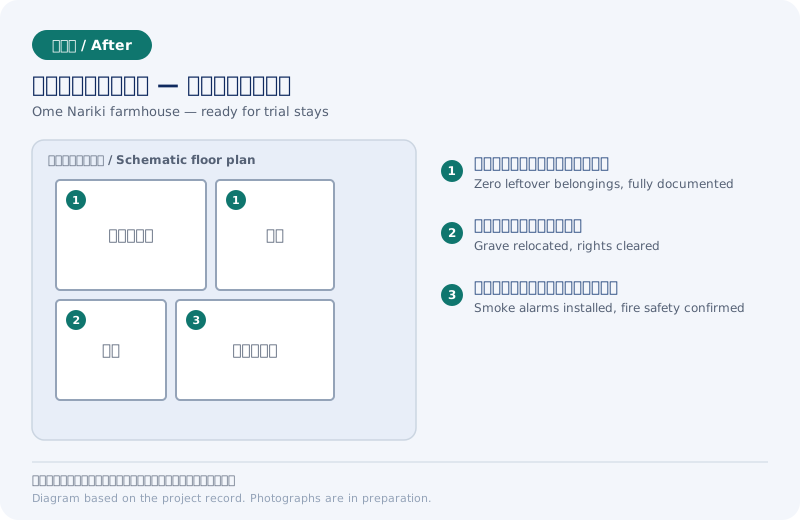
Lifting the tatami, letting out the air that had long stagnated beneath the floor, recording the condition photograph by photograph, the house drew slowly closer to a state of zero left-behind belongings. On the afternoon we finished carrying everything out, the low western sun broke through a gap in the clouds and reached far into the bare tatami room. Motes of dust drifted slowly through the band of light, and when someone walked, only the creak of the floorboards escaped up into the high ceiling. Emptied at last, the house took on a quiet expression, waiting for "the next someone." Only once a house is empty can a buyer picture "a life of their own." The order cannot be skipped.
Once the house is empty, the meaning of the photographs you post changes too. Instead of a dim interior cluttered with a stranger's belongings, you can now shoot a bare, sunlit room. For one and the same house, whether the left-behind belongings are there or not, the impression the person on the other side of the screen receives is entirely different. It is the empty photograph, precisely, that surrenders the place to the imagination of a would-be buyer far away. Only on seeing a photo of the low western sun stretching long across a well-swept veranda does someone first think, "I'd like to sit here." Clearing out is at once the groundwork for selling a house and the work of making a doorway through which someone else's imagination can enter.
Settle the Grave Relocation First
At a rural vacant house, ancestral graves going back generations may remain in a corner of the grounds or on a slope a little way off. This property was no exception. For a buyer raised in the city, shouldering the question of "what am I supposed to do about this grave?" along with the house, after buying it, weighs far more heavily than any talk of floor plans or price. Can they keep up the cleaning and the visits; and if they cannot, then what? Carrying a question so hard to answer, a person cannot bring themselves to take the leap of relocating.
And so, before putting the house on the market, we decided to settle the grave relocation — what is called *hakajimai*, the closing of a grave — first. We went back and forth with the owner's relatives many times by phone and in writing, advancing the procedures at the temple and the municipal office one step at a time. The exchange of documents alone took weeks, and aligning the dates for the memorial service and the new resting place for the remains took longer still. This is a step that must not be hurried. I still remember an elderly relative standing before the grave, palms pressed together in silence for a long, long time. It was a quiet, weighted stretch of time, of an entirely different quality from the sweat of clearing out. To "put the rights in order" is a phrase on paper, and at the same time it is the work of letting someone bring their feelings to a point of closure.
With the grave relocation settled, a buyer can move into this house unencumbered, thinking only about the life ahead. It is an item that appears nowhere on the price sheet, yet for someone weighing a move it becomes a reassurance larger than they might imagine. What comes with a house is not only its floor plan and its land. It also means handing on, to the next person, the whole span of time that land has carried. That is exactly why we, the side handing it over, put things in order in advance, up to the point where it can be handed over. That, I believe, is the most practical form of good faith toward a buyer coming from far away. A house passed on only after it has been brought to closure does not cloud the next resident's life with needless shadows.
Confirm Fire-Safety Compliance
To host a trial stay — having someone actually stay for a few days and test the living for themselves, with their own body — the safety of the house as a dwelling is the fundamental premise. The older the house, the more this can never be skipped. On atmosphere alone, no one can sleep at ease.
Whether smoke alarms are correctly installed in the rooms that require them, whether their batteries are alive, whether the old wiring is under any strain — we inspected each point, repaired what was lacking, and only after confirming fire-safety compliance did we make the house public. Alongside that, we ran the water until the rusty, cloudy flow came clear, traced the marks of leaks all the way up into the ceiling cavity, and fixed the fit of the storm shutters and screen doors. Going around to the back garden, we cut the grass that had run wild and swept the fallen leaves piled on the veranda. A house with a hearth has, in that one feature, enough atmosphere to move the heart — and it is, at the same time, a place demanding more care than most in the handling of fire. That someone staying in this house for the first time, gazing up into the high, dark rafters, can nonetheless fall asleep at ease: this confirmation, which never appears in any photograph, is the true foundation of a trial stay.
Standing in the house now that everything is in order, the room with the hearth is strangely quiet, and warm. The first person to take a trial stay here — what will they think, come morning, on this veranda? Someone worn out by city life; a younger generation drawn to the work of the mountains; or perhaps someone from across the sea. For that person, whose face we do not even know, we polish the floors and wipe the windows. Reviving a vacant house is at once the work of carefully clearing away someone's past, and the work of preparing, a step ahead of time, the future of someone we have not yet met.
The work began in winter, and by spring the grass around the house had all budded at once. Summer's mowing left us drenched in sweat from head to toe, and by autumn fallen leaves once more piled on the veranda. Over the course of a single turn of the four seasons, the house gradually regained a face able to welcome people. Clearing out, grave relocation, safety checks — every one of them an unglamorous, plain step. But only once all three are done can the house at last stand at the doorway of "stay, confirm the living for yourself, and then decide." At AkiyaWay, we have laid out a path by which someone actually stays, on a trial stay, in a house prepared step by step like this, and moves on to a purchase consultation before the warmth of that stay has cooled. For those who live far away, and for those who take an interest from across the sea, we have assembled multilingual guidance so that they can begin the conversation in their own native language. That low western sun that reached so long into the bare tatami room — who will be the next to look up into it? So that this person can take a first step without carrying needless anxiety, we go on today, too, stacking up one unphotogenic step at a time.